

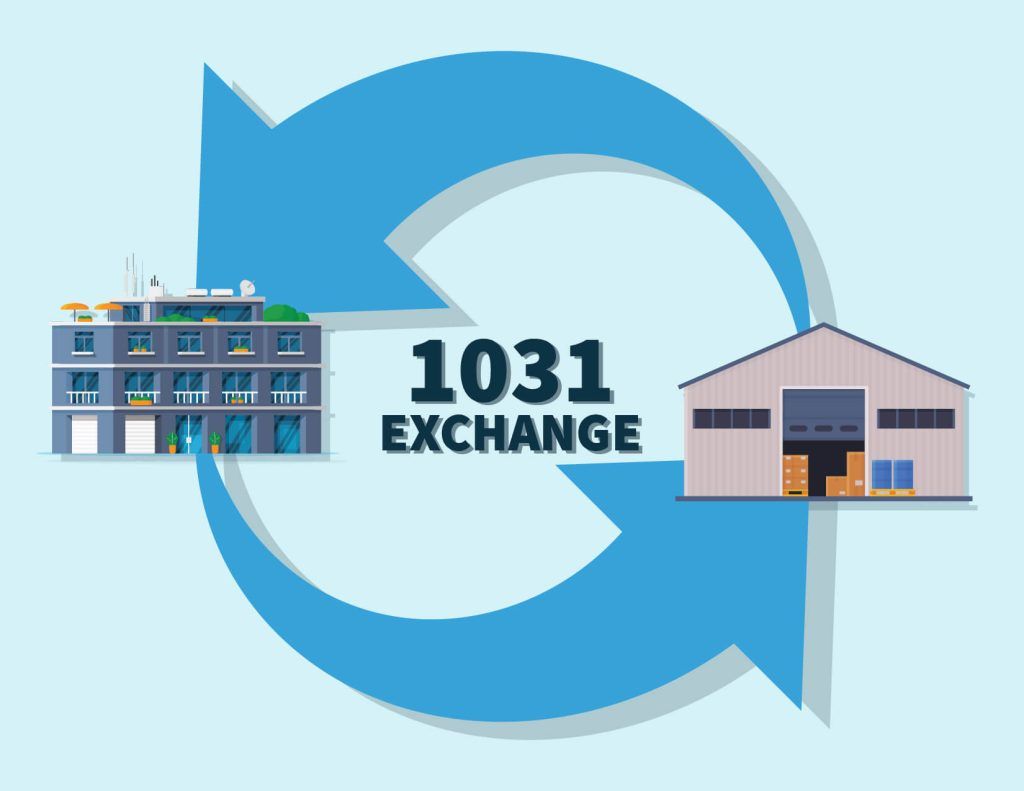
Anyone involved in real estate investing has likely heard of a 1031 exchange. For many investors, it has become a valuable tool for deferring capital gains taxes while continuing to grow a real estate portfolio. But, what are the advantages and disadvantages? What limitations should investors be aware of? Is it accessible to everyone, and where did the name even come from? Let's dive in.
Firstly, let's define what a 1031 exchange is in simple terms: An investor who sells one property can defer capital gains taxes by soon-after exchanging or re-investing their profits into another rental property.
Let's look at a scenario where the 1031 code could have been utilized but was not, and quantify the wealth loss in real numbers. For illustrative purposes, the scenario below assumes an approximate effective capital gains tax rate of 25% and that the taxable capital gain is on the increase in value (and not the more realistic value that is Cost Basis which was addressed within last quarter’s newsletter).
Scenario:
Year 0: You purchase a property for $11M using $3M of your own cash and an $8M loan (with interest only terms).
Year 5 (Part 1): The property goes up in value and you sell it for $15M. Your profits are $15M minus the $8M loan = $7M. But, you need to pay capital gains tax on the price difference: 25% x ($15M-$11M) = $1M tax bill, so your profits are $6M, instead of the aforementioned $7M.
Now let’s repeat the cycle with your new profits.
Year 5 (Part 2): Using the above $6M of earnings plus a $16M loan (also with IO terms), you purchase a property for $22M.
Year 10: The property goes up in value and you sell it for $30M. Your profits would be $30M minus the $16M loan = $14M. But, you need to pay capital gains tax on the price difference: 25% x ($30M-$22M) = $2M tax bill, so your profits are $12M instead of the $14M.
Let's understand better what is happening. Every (5-year) cycle, your equity is being compounded and roughly doubling. Similarly, your tax bill is too. In the first exchange you missed out on $1M in taxes to reinvest, in the second exchange, it was $2M. If this cycle keeps re-occurring, your tax bill will be another $4M, $8M, etc. for each exchange.
With a deeper look, by Year 10, you didn't miss out on only the $3M, because that $1M loss at Year 5 could have been worth $2M in equity by Year 10. So in 10 years you invested $3M and forfeited the opportunity to reinvest the capital was paid in taxes and compounded to $4M ($1M in Year 5 that could have been worth $2M, and $2M from the second exchange by Year 10) and thus your profits could have grown to be $16M, but instead you have $12M.
With this in mind, often doing a 1031 into a property with “B+” returns can still put an investor ahead of a scenario where an investor pays the capital gains taxes and waits around for “A+” property to come along. Further benefits that result from deferring taxes include the following. Investors can increase their purchasing power by qualifying for larger acquisitions and receive better financing because of it. Secondly, with more capital to deploy, investors can build a stronger and more diversified portfolio. Thirdly, a 1031 exchange can be used to shift from more passive investments (such as Delaware Statutory Trusts) to more actively managed assets (e.g., apartments), or vice versa.
The extraordinary benefits of a 1031 exchange are clear. However, in addition to there being very specific requirements on the number and kind of exchange assets, there’s an overall catch when executing a 1031 exchange. That is, once you sell your property, you have 45 days to find a replacement property and then 180 days (from the sale) to close on the property. There is zero wiggle room; weekends, federal holidays, force majeure, cannot extend this exact deadline. Miss either deadline by an hour and you get a hefty tax bill. Think this is tight? For perspective, before 1984, the tax code said that you had to sell your old property and close on your replacement all in the same 24 hours! Yikes!
So you might be wondering, as part of the tax code, arguably the most famous code in the IRS, which saves investors huge sums of capital and is a powerful source of building generational wealth, where did 1031 get its famous name from? Well, here's the very underwhelming answer. There are 9,834 codes and roughly 2,500 pages in the Tax section (Sec. 26) and the famous 1031 is nothing more than the 1,031st code that codifies exchanging like-kind real estate properties.
Whether you've completed multiple 1031 exchanges, have only heard the term in passing, or are considering selling an investment property for the first time, one thing is clear: a 1031 exchange can be an incredibly powerful wealth-building tool when executed correctly. The benefits are significant, but so are the planning and execution requirements.
With strict IRS deadlines and little room for error, working with an experienced team can make all the difference. PREP has extensive experience helping investors navigate the 1031 exchange process, providing the guidance and coordination needed to help ensure a smooth and successful transaction.