
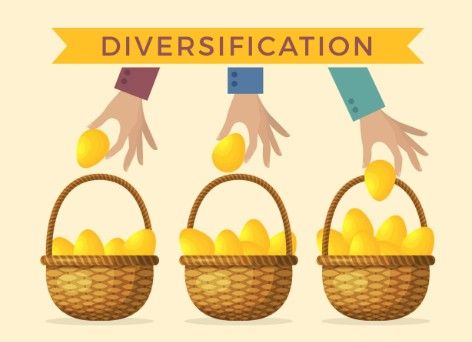
It is often said that the three most important words in real estate are: Location, Location, Location. At PREP, we like to say that there’s a fourth - Diversification. Why is Diversification so critical for successful real estate investing?
Consider the following hypothetical scenario by a real estate investor:
They have $200K to invest, and are considering investing it in either a property in Indianapolis with an anticipated Annualized Return (AR) of 17%, or an investment offering in Salt Lake City with an anticipated AR of 14%.
Isn’t it obvious that they should invest the entire $200K into the Indianapolis deal given the higher anticipated AR?
Let's look at several reasons why it’s important to factor diversification into this decision:
Varying Markets: While analysts underwrite deals to the best of their ability, ultimately investments come with inherent risk (which will be quantified in #3 below). This can include new local legislation inhibiting revenue, natural disasters causing damage, population growth trends shift, etc. Therefore, if you ”split the pot,” while you theoretically might gain a lesser amount, the risk of losing equity is much lower - if one market softens and the other strengthens, the average cash flow and average return metrics will be more steady.
Staggered Liquidity: In a healthy portfolio, you ideally want your cash to become liquid at different times. If you have $500K locked up in a deal for seven years, from a cash liquidity perspective, it would be better if it were invested in five different deals providing $100K of liquidity every two years. You could choose to reinvest that money, or save it for a monumental life expense.
Risk Adjustment / Expected Value Theory: Let's assume the probability of achieving the 17% AR in the Indianapolis deal and 14% AR in the Salt Lake City deal is 70% and 90%, respectively.
Scenario #1
Adjusting the return for the probability of success vs. failure (70% vs. 30%), we can assume that the average expected return is 0.70 ($200K×1.17) + 0.30 ($200K) = $223,800. (So, in theory, if you were to make this investment over and over again, your value would increase but sometimes the value would remain stagnant or decrease, and on average after one year your expected value would be $223.8K.)
However, let's look at what the expected return would be if we diversified by splitting the equity between the two deals.
Scenario #2
Expected return for the Indianapolis deal: 0.70 ($100K×1.17) + 0.30 ($100K) = $111,900.
Expected return for the Salt Lake City deal: 0.90 ($100K×1.14) + 0.10 ($100K) = $112,600.
Summing the $111,900 and $112,600 = $224,500, which is greater than the $223,800 from Scenario #1.
This is a simplified example that quantifies a key takeaway: Diversification can help reduce concentration risk and create a more resilient portfolio over time.
There are also different methods of diversifying. Diversification is akin to casting multiple fishing rods in the hopes of catching as many fish as possible, where fish are your ROI and the rods are your investments. You can cast the rods all around your boat, spread them throughout different parts of the lake, or even place each rod in different bodies of water. All of these scenarios increase your probability of catching fish, and no one method is the only correct one. One can diversify across different multifamily real estate investments, or across various real estate asset classes. Of course, as we know, the same applies for investments outside of the real estate sector as well.
Diversification is the main reason that we encourage our investors to invest in more than one deal. When appropriate, the ideal goal for you as a PREP investor is to look at the returns of your portfolio as a whole, and place less emphasis on the performance of each particular deal. While one investment may be a ”home run” and you might wish that you had invested more, if another does not perform as well as expected, you can sleep at night knowing that it is only one part of a strong and diversified portfolio. And at PREP we sleep well, when our investors sleep well!
Written By:
Donny S. Steinberg
Director of Strategy & Innovation